Every satoshi leaves a trail.
Follow it.
Since the genesis block, every Bitcoin transaction is permanently public. Flow turns that record into a modern explorer for everyone: see who moves together, where value went, and what an inscription has been through.
Full-chain clustering · Interactive flow tracing · Ordinals & OP_RETURN · Community attribution · Free during beta · Shared traces need no account
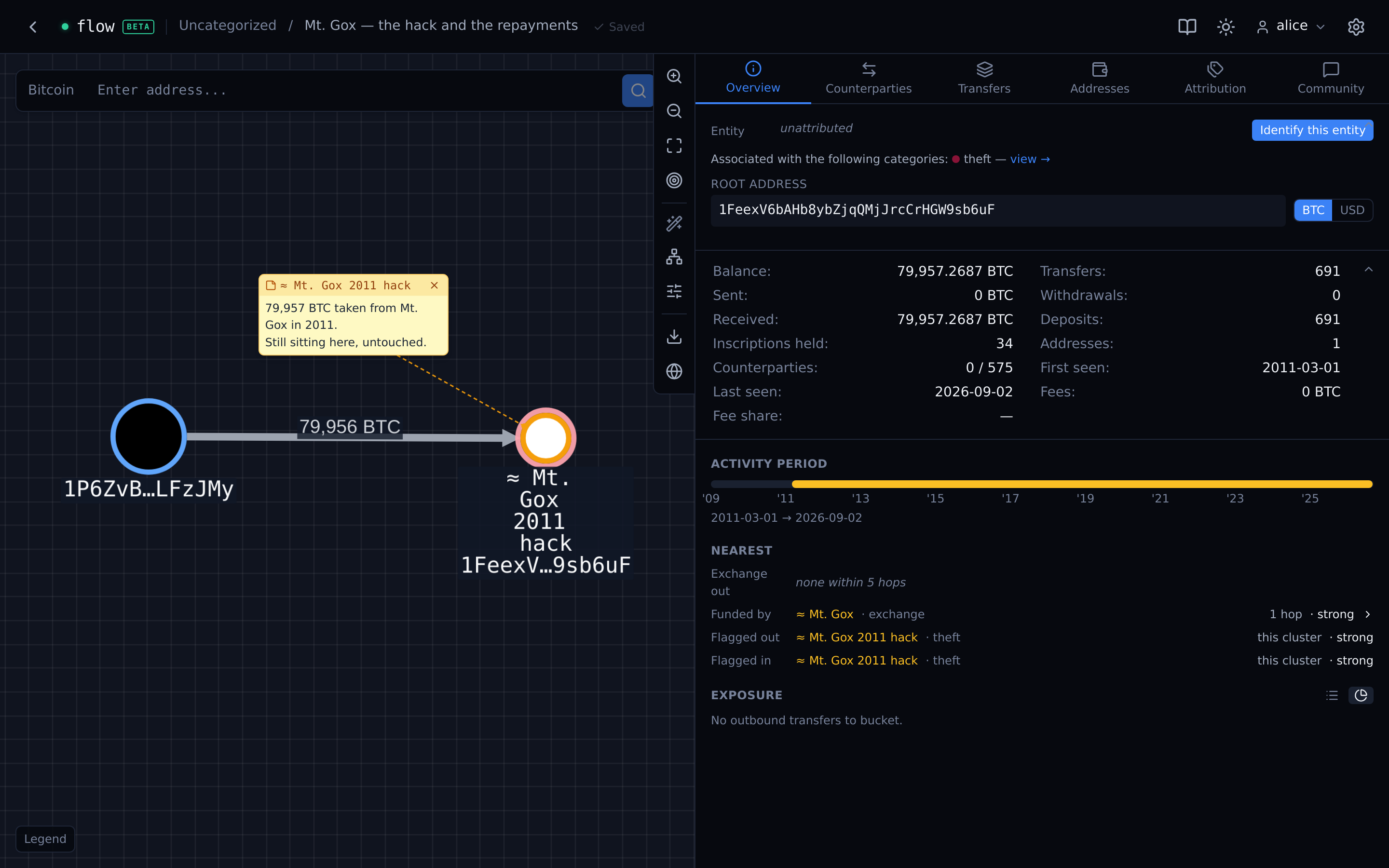
Follow the inscription,
not just the coin.
Every inscription is a sat with a history. Flow follows it hop by hop from the reveal — through every wallet and marketplace it passes — and shows you the picture, the video or the words right in the row.
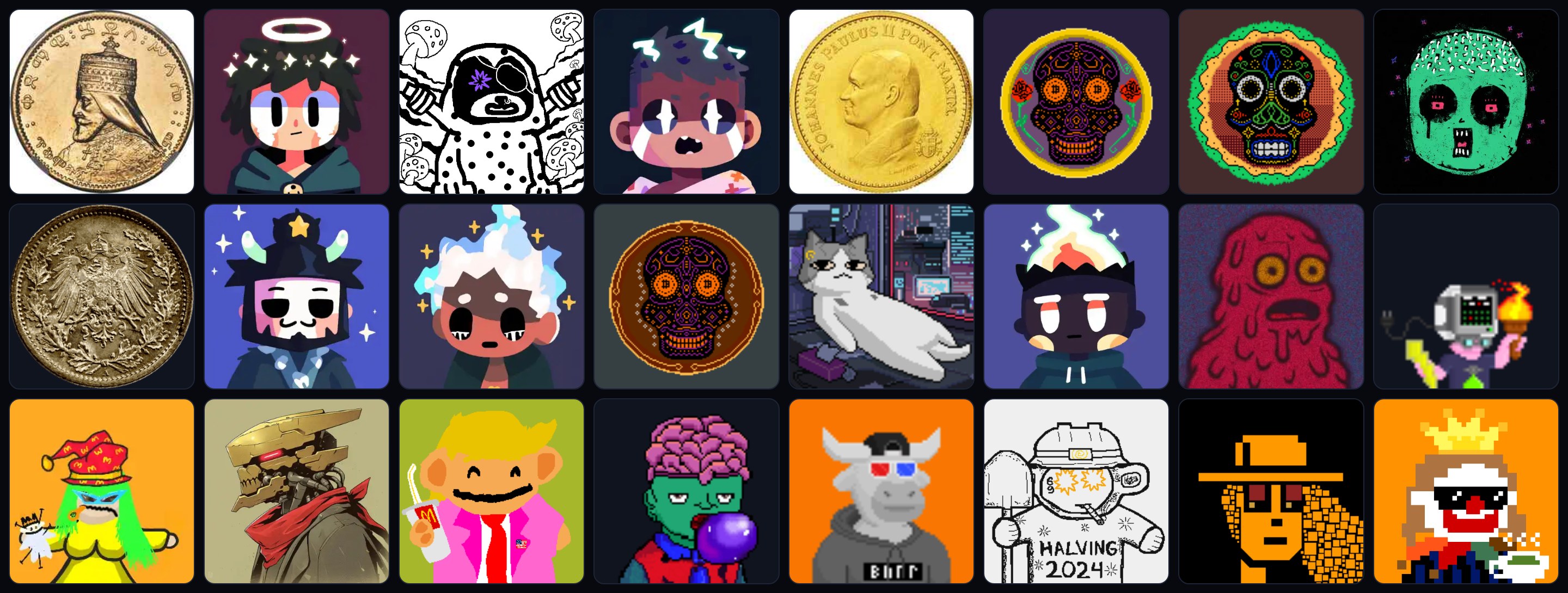
A cluster’s Transfers switch to Ordinals and read like its bitcoin history: what it holds now, what came in, what went out, and from whom. A BRC-20 transfer, a name registration, a bitmap claim — in plain words, not markup. Add one move, or an inscription’s whole history, to the canvas as its own layer.
People talk on the ledger too. OP_RETURN notes and runestones decode in the same place — block 965,818 carried we are whitehats. contact us on chain
.
Follow the money.
Literally.
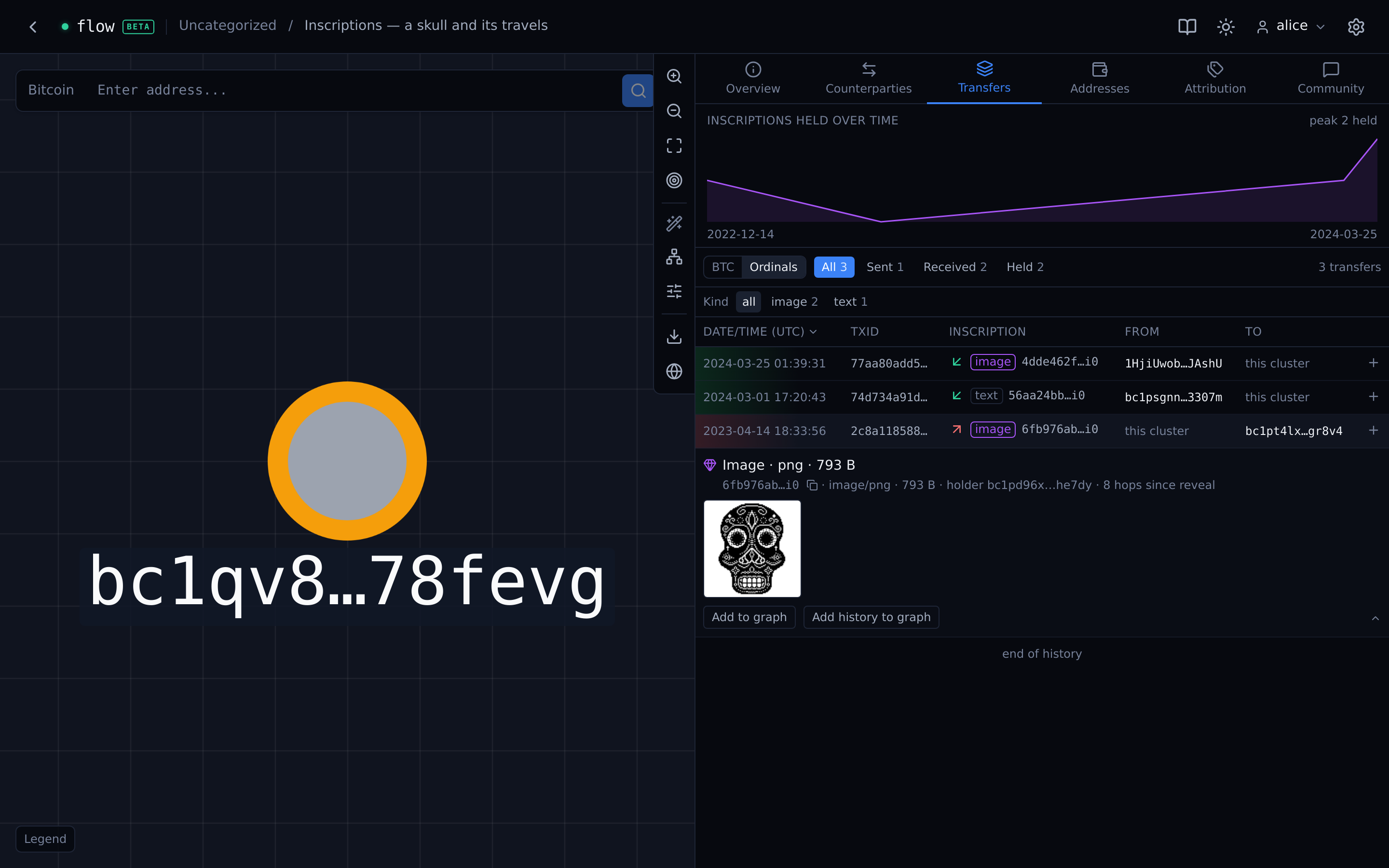
The Canvas is an interactive flow graph. Start from any transaction or Bitcoin address and pull the thread.
Expand inputs and outputs hop by hop. Collapse noise. Pin what matters. Watch value split, merge, peel, and consolidate across thousands of transactions — laid out so a human can actually read it. When a trace crosses into a labeled cluster — an exchange, a mining pool, a marketplace — the graph says so, right on the node, with the sources one click away.
Every flow is priced at the moment it moved — because “451 BTC in 2013” and “451 BTC today” are different stories, and the story needs both.
Open the CanvasWho moves together?
Flow clusters all 1.5 billion Bitcoin addresses on the chain — co-spend and other heuristics resolve them into entities you can query in under a second.
No sampling. No “contact sales for full history.” The whole chain, or it doesn’t count.
Search an address or transactionEvery cluster has a tell.
Exchanges batch. Mixers churn. Cold storage sleeps. Bots never do. Flow precomputes a behavioral signature for every cluster on the chain — a measured pattern, never a verdict, with the reasons shown.
Exchange-like
The deposit-and-batch rhythm of a custodial service.
Mixer-like
The hallmarks of deliberate trail-breaking.
Cold-storage-like
Long accumulation, then quiet.
Bot-like
Automation, not a person.
Name it together.
Two kinds of names on the map. Platform labels are published facts — an exchange’s own proof-of-reserves file, an official list — imported and cited. Community labels are the fun part: you know who a wallet belongs to, you say so, you show your source, and the rest of us weigh in.
Propose
Pick a cluster, hit Identify this entity, type the name, paste the source. A label without a source goes nowhere.
Weigh
Others vote. Weight follows track record — being right counts, volume doesn’t, and nobody can buy it.
Review
A curator signs off before a name renders on the map, always with a ≈ and its confidence. Unsupported labels expire.
Every label that survives makes the next trace faster for everyone. Names describe wallets and services, never people.
Open data deserves open tools.
The Bitcoin ledger is the largest public dataset in finance, and most people have only ever seen it one transaction at a time. Flow is for reading it whole — for the curious, for analysts, researchers, writers and builders, and for anyone who wants to know what actually happened to a coin.
Who moves together. Where an exchange’s coins go and where they came from. What a mining pool did with its rewards. Which wallet holds the inscription you are looking at, and every hand it passed through to get there. Questions like these used to need a data team; now they need a browser and an afternoon.
Labels are the community’s work, and they stay honest: every one carries its sources and its confidence, and a ≈ in front of a name means “hypothesis”. Flow describes wallets and services. It never claims to know who a person is.
Our principlesNo foundation behind us.
Bitcoin has no foundation, and neither does Flow.
Explorers on other chains grew up with one — Etherscan, for example, was backed by Ethereum Foundation grants. Nothing like that pays for followthesats. Full-chain clustering across 1.5 billion addresses runs on hardware and bandwidth that somebody has to fund, so we charge — mostly Enterprise: exchanges, foundations, custodians and research teams that need scale, citations and workspaces. Supporter subscriptions follow once the beta ends.
That is what keeps the public tier free. We hope Flow is useful to everyone; the ones who need the most of it fund it for the rest. See how the tiers work.
Pick a transaction. Follow it to the edge.
Pull the thread and see where it goes. Free during the beta.
Try Flow